
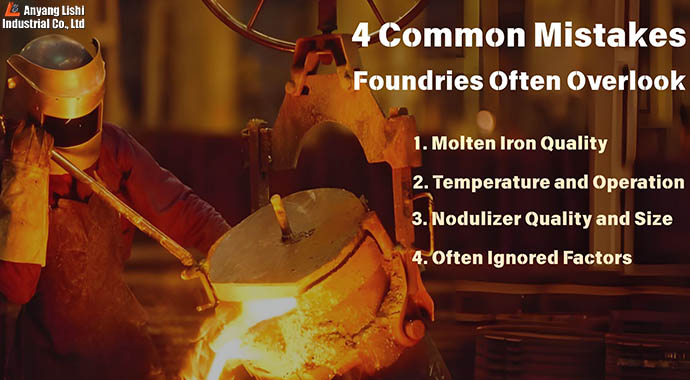
4 Common Mistakes Foundries Often Overlook
Poor nodulization is one of the most frustrating problems in ductile iron production.
When castings are opened and graphite appears flake-like or irregular instead of spherical, the result is often scrap, rework, or serious mechanical property loss.
Many foundries first blame the nodulizer itself.
However, based on years of on-site experience, most nodularity problems are caused not by the nodulizer quality, but by improper use and process control.
This article explains the four main reasons why nodularity fails or fades in real production.
1. Poor Molten Iron Quality (High Sulfur and Oxidation)
This is the most common root cause.
Magnesium and rare earth elements in nodulizers are expensive and highly reactive.
Their job is to transform graphite into spheroidal form.
If the molten iron is “dirty,” these elements are consumed before nodulization even starts.
Typical problems include:
??High sulfur content
Sulfur is the strongest anti-nodularizing element.
When sulfur exceeds 0.10%, magnesium is first consumed to neutralize sulfur, leaving insufficient residual Mg for graphite spheroidization.
??Oxidized molten iron
Rusty scrap, poor melting practice, or tapping the last iron from the furnace increases oxygen content.
Magnesium reacts violently with oxygen, causing severe Mg loss.
??Incomplete desulfurization
If sulfur is not removed before treatment, the nodulizer is forced to act as a desulfurizer, resulting in low nodulization efficiency and high cost.
2. Improper Treatment Temperature and Operation
Small operational mistakes can lead to big differences in nodularity.
??Temperature too high
Excessive temperature causes violent reactions and rapid magnesium evaporation before it can dissolve into the melt.
??Temperature too low
The nodulizer may freeze or sinter at the ladle bottom, failing to react effectively.
??Poor cover practice
If the nodulizer is not properly buried or covered, magnesium vapor escapes instead of entering the molten iron.
??Process delays and ladle issues
Early addition, wet ladles, or unclean ladles all contribute to Mg loss and unstable results.
3. Nodulizer Quality and Size Selection
Even with good process control, the wrong nodulizer selection can cause failure.
??Low-quality nodulizer
High MgO content (>1%) or insufficient calcium increases slag formation and reduces effective Mg recovery.
??Incorrect particle size
Oversized lumps melt too slowly
Too many fines cause overly violent reactions and severe Mg burn-off
??Oxidized or expired material
Improper storage leads to oxidation, making the nodulizer ineffective.
4. Often Ignored Factors
Some problems are easy to overlook but highly destructive.
??Slag carryover from the holding furnace
High-sulfur, high-oxygen slag rapidly consumes nodulizing elements.
??Improper ladle design
An unsuitable depth-to-diameter ratio reduces reaction efficiency and Mg recovery.
Conclusion
Poor nodulization is not a random issue.
It is the direct result of insufficient residual magnesium and rare earth elements caused by iron quality, process errors, or incorrect nodulizer selection.
In the next article, we will explain how to systematically solve these problems and achieve stable nodularity in production.